





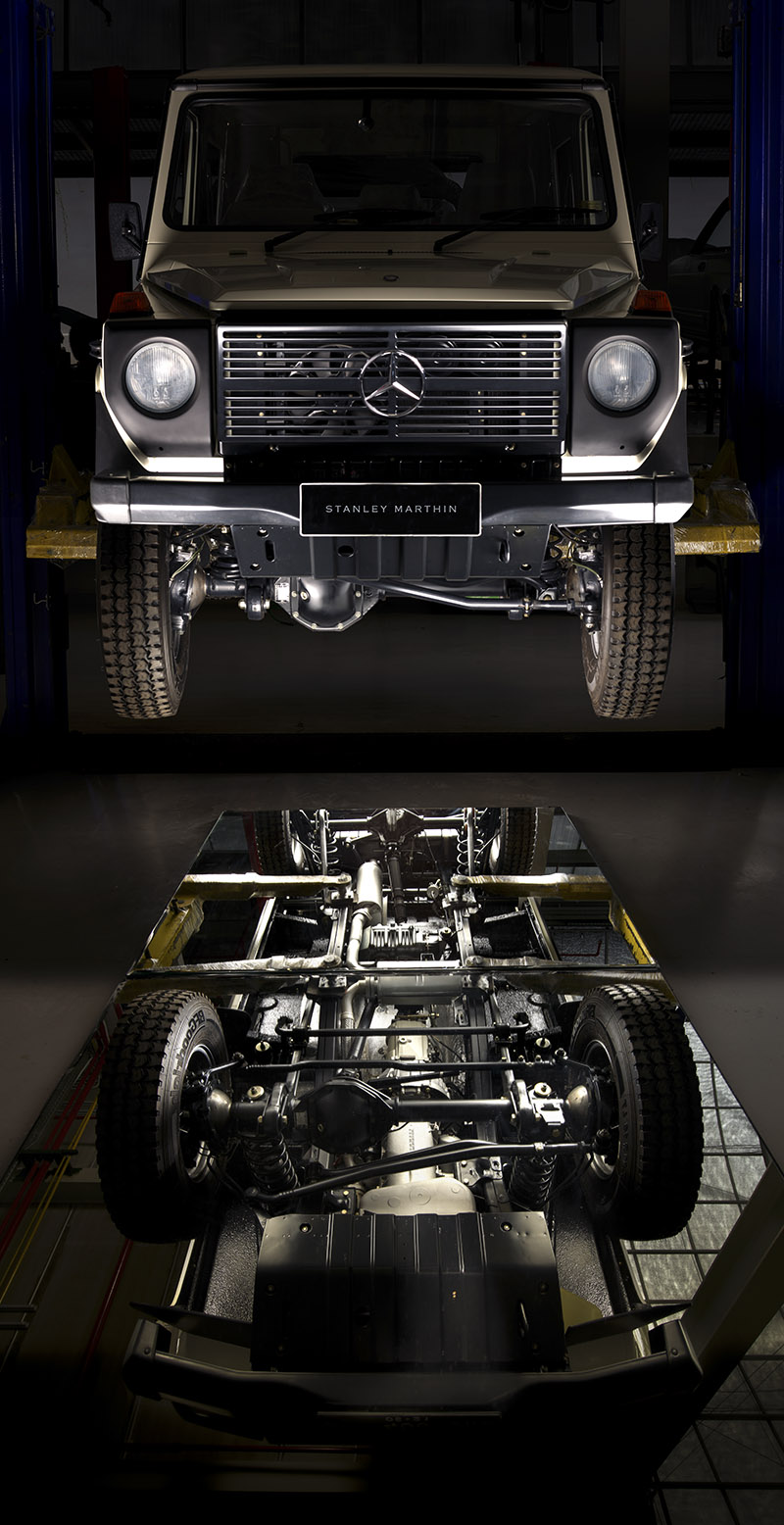


MERCEDES BENZ GE280
The Mercedes-Benz G-Class, sometimes called G-Wagen (short for Geländewagen, “cross country vehicle”), is a mid-size four-wheel drive luxury SUV manufactured by Magna Steyr (formerly Steyr-Daimler-Puch) in Austria and sold by Mercedes-Benz. In certain markets, it has been sold under the Puch name as Puch G.
The G-Wagen is characterised by its boxy styling and body-on-frame construction. It uses three fully locking differentials, one of the few vehicles to have such a feature.
Despite the introduction of an intended replacement, the unibody SUV Mercedes-Benz GL-Class in 2006, the G-Class is still in production and is one of the longest produced vehicles in Daimler’s history, with a span of 35 years. Only the Unimog surpasses it.
The G-class was developed as a military vehicle from a suggestion by the Shah of Iran (at the time a significant Mercedes shareholder) to Mercedes and offered as a civilian version in 1979. In this role it is sometimes referred to as the “Wolf”. The Peugeot P4 was a variant made under licence in France with a Peugeot engine. The first military in the world to use it was the Argentine Army (Ejército Argentino) beginning in 1981 with the military model 461.
The development of the G-Class started in 1972 with a cooperative agreement between Daimler-Benz and Steyr-Daimler-Puch in Graz, Austria. Mercedes-Benz engineers in Stuttgart were in charge of design and testing, while the team in Graz developed the production plans. The first wooden model was presented to Daimler-Benz management in 1973, with the first drivable prototype beginning various testing including German coalfields, the Sahara Desert, and the Arctic Circle in 1974. Construction commenced on a new production facility in Graz, where the new cross-country vehicle would be assembled nearly entirely by hand in 1975, with production of the “G Model” beginning in Graz in 1979. In 1980, the Vatican took delivery of a specially made G-Wagen outfitted with a clear thermoplastic top which served as the Popemobile. The “Papa G” later took up permanent residence at the Mercedes-Benz Museum in Stuttgart, Germany.
The first major refinements were introduced in 1981, including an automatic transmission, air conditioning, an auxiliary fuel tank, protective headlamp grilles and a cable winch. Fuel injection became available in 1982, when the 230 GE was introduced in Turin, along with more comfortable and supportive front seats, auxiliary heating, wider tires and fender flares. For 1985, differential locks, central door locking and a tachometer became standard and by 1986 over 50,000 G Models had been produced.
 |
During the fourteen months restoration of the black Mercedes Benz 190SL, Stanley Marthin had successfully minimized the cost by restoring most parts down to its details instead of replacing them with a new one. As an example, the Mercedes Benz word and logo were only restored in their original, and thus helped reduce the cost by almost 300 million in Indonesian rupiah altogether. Through a long process of engine, interior, bodyworks and chasis restoration, the vehicle has been restored fully to its peak condition, both visually and technically.Marthin admitted that it was a tough process to restore the car, as it carried a rich classical value with its signature curvy countour on the exterior. However, his commitment and high level of craftmanship brought the car back to its fullest condition with fresh black paints, beautifully crafted brown leather seats and interior, as well as a restored full power engine.
Resources: |
MERCEDES BENZ GE280
The Mercedes-Benz G-Class, sometimes called G-Wagen (short for Geländewagen, “cross country vehicle”), is a mid-size four-wheel drive luxury SUV manufactured by Magna Steyr (formerly Steyr-Daimler-Puch) in Austria and sold by Mercedes-Benz. In certain markets, it has been sold under the Puch name as Puch G.
The G-Wagen is characterised by its boxy styling and body-on-frame construction. It uses three fully locking differentials, one of the few vehicles to have such a feature.
Despite the introduction of an intended replacement, the unibody SUV Mercedes-Benz GL-Class in 2006, the G-Class is still in production and is one of the longest produced vehicles in Daimler’s history, with a span of 35 years. Only the Unimog surpasses it.
The G-class was developed as a military vehicle from a suggestion by the Shah of Iran (at the time a significant Mercedes shareholder) to Mercedes[5] and offered as a civilian version in 1979. In this role it is sometimes referred to as the “Wolf”. The Peugeot P4 was a variant made under licence in France with a Peugeot engine. The first military in the world to use it was the Argentine Army (Ejército Argentino) beginning in 1981 with the military model 461.
The development of the G-Class started in 1972 with a cooperative agreement between Daimler-Benz and Steyr-Daimler-Puch in Graz, Austria. Mercedes-Benz engineers in Stuttgart were in charge of design and testing, while the team in Graz developed the production plans. The first wooden model was presented to Daimler-Benz management in 1973, with the first drivable prototype beginning various testing including German coalfields, the Sahara Desert, and the Arctic Circle in 1974. Construction commenced on a new production facility in Graz, where the new cross-country vehicle would be assembled nearly entirely by hand in 1975, with production of the “G Model” beginning in Graz in 1979. In 1980, the Vatican took delivery of a specially made G-Wagen outfitted with a clear thermoplastic top which served as the Popemobile. The “Papa G” later took up permanent residence at the Mercedes-Benz Museum in Stuttgart, Germany.
The first major refinements were introduced in 1981, including an automatic transmission, air conditioning, an auxiliary fuel tank, protective headlamp grilles and a cable winch. Fuel injection became available in 1982, when the 230 GE was introduced in Turin,[6] along with more comfortable and supportive front seats, auxiliary heating, wider tires and fender flares. For 1985, differential locks, central door locking and a tachometer became standard and by 1986 over 50,000 G Models had been produced.
|
During the fourteen months restoration of the black Mercedes Benz 190SL, Stanley Marthin had successfully minimized the cost by restoring most parts down to its details instead of replacing them with a new one. As an example, the Mercedes Benz word and logo were only restored in their original, and thus helped reduce the cost by almost 300 million in Indonesian rupiah altogether. Through a long process of engine, interior, bodyworks and chasis restoration, the vehicle has been restored fully to its peak condition, both visually and technically.Marthin admitted that it was a tough process to restore the car, as it carried a rich classical value with its signature curvy countour on the exterior. However, his commitment and high level of craftmanship brought the car back to its fullest condition with fresh black paints, beautifully crafted brown leather seats and interior, as well as a restored full power engine.
Resources: |
